


If you searched for this because DJI's newer Matrice 400 has you wondering whether your Matrice 350 RTK fleet is still worth protecting, the short answer is yes. The two questions aren't actually related.
The Matrice 350 RTK is still one of DJI's actively sold, actively deployed enterprise platforms in 2026. It sits alongside the Matrice 400 in DJI's current lineup, not behind it. DJI positions it as the cost-effective, proven choice for standard mapping, inspection, and surveying work, at a price several thousand dollars below the M400. Fleets that already run M350s aren't retiring them just because a newer model exists, and new buyers with standard mission profiles are still choosing it. Whether you fly an M350 or an M400 also has no bearing on whether you need a compliant path to C5/C6. If your operation calls for VLOS flight over a controlled ground area (STS-01) or BVLOS flight in a sparsely populated area (STS-02), that requirement applies to whatever aircraft you're flying today.
What Does This Mean for M350 Operators in Europe?
Before choosing a recovery system, there is an important distinction to make.
The standard DJI Matrice 350 RTK is listed by EASA as a C3 aircraft. Some specific third-party M350 configurations have separately been assessed and listed as C5 configurations, allowing them to be used within the relevant STS-01 framework. These are specific aircraft-and-kit configurations, not a status automatically created by installing any parachute.
That distinction matters when evaluating parachute systems.
Installing a third-party parachute does not, by itself, turn an M350 RTK into a C5 or C6 aircraft.
A parachute manufacturer may provide a recovery system with tested performance and technical documentation, but that is different from an EASA-recognised C5/C6 configuration or an EU Declaration of Conformity for a specific kit.
For operators pursuing an STS route, the aircraft configuration must meet the applicable requirements of that specific scenario. For other operations in the Specific category, an individual operational risk assessment and authorisation may be required.
So where does a parachute fit?
A recovery system should therefore be evaluated first as a safety system, rather than assumed to be a regulatory shortcut.
Under SORA, parachutes are recognised as an example of an M2 mitigation, intended to reduce the effects of a ground impact after control of the aircraft has been lost. The value of the system is therefore tied to its demonstrated performance, robustness and supporting evidence.
For an M350 operator, useful information can include:
- deployment performance and reliability;
- measured descent rate;
- impact-energy or related recovery data;
- activation logic;
- motor-stop behaviour;
- redundancy and backup power;
- installation and maintenance procedures;
- test reports and technical documentation.
These are the kinds of details worth comparing when deciding which recovery system is appropriate for an existing M350 fleet.
Is the Matrice 350 RTK still worth investing in?
Short answer: yes. A few reasons this keeps coming up in 2026 buying guides across the industry:
- It's still current, not discontinued. DJI continues to sell and support the M350 RTK as a flagship platform in its own right.
- The price gap is real. Multiple industry comparisons put the M400 several thousand dollars above the M350 RTK. That gap matters for fleets buying multiple units or working with tighter budgets.
- Most missions don't need the M400's extra capability. The M400's advantages — greater payload capacity, LiDAR/mmWave obstacle sensing, and longer endurance — matter most for complex multi-sensor missions. Standard inspection and mapping work runs perfectly well on the M350 RTK.
- The installed base is enormous. Years of M350 and M300 deployment mean a huge number of operators already have capital committed to the platform, with no operational reason to migrate early.
None of that changes because a newer model exists. In practical terms: if you're planning STS-01 or STS-02 operations on an M350 fleet, that compliance work is relevant today, not something to defer until a hypothetical future upgrade.
The ground risk buffer: why your parachute's specs directly set your operating limits
Under STS-01, the controlled ground area you operate over has to include a ground risk buffer — a minimum distance beyond your flight and contingency areas, sized according to your aircraft's maximum operating height and weight class:
| Max operating height (AGL) | MTOM up to 10 kg | MTOM above 10 kg |
| 30 m | 10 m | 20 m |
| 60 m | 15 m | 30 m |
| 90 m | 20 m | 45 m |
| 120 m | 25 m | 60 m |
The descent rate and distance an aircraft travels after FTS activation has to fit within that buffer as specified in the manufacturer's instructions. Put simply: a slower, more controlled descent with a smaller drift distance gives you a smaller required buffer, and that decides how close you're allowed to operate to people, roads, and property. A recovery system that's poorly documented, or whose descent characteristics haven't been properly tested and specified, leaves you either guessing at your buffer size or forced into a larger one than your actual equipment justifies. This is exactly the kind of technical data your parachute vendor should be able to hand you, not something you should have to estimate yourself.
The Matrice 350 RTK parachute buying checklist
With that regulatory backdrop in mind, here's what separates the best parachute for Matrice 350 operators from one that only looks the part on a spec sheet:
- Deployment response time. How long from anomaly detection to full canopy deployment? Faster response means more usable altitude to complete a safe descent. It matters most on lower-altitude missions where you have the least margin to work with.
- Descent rate and documented impact energy. Ask for the actual sink rate in m/s and the resulting impact kinetic energy in joules, tested and stated by the manufacturer rather than estimated. This is the number that feeds directly into your ground risk buffer calculation above.
- Flight-controller-level integration, not just a mechanical trigger. A system that only pops a canopy — without coordinating a motor-stop command through the flight controller first — risks the parachute lines tangling with propellers that are still spinning during descent. Look for systems that communicate directly with the aircraft's flight control system and sequence motor shutdown before deployment.
- Sensor redundancy. Dual or redundant IMU sensors matter here. If one sensor path fails or gives a false reading, a second independent path should be able to take over the decision-making without a gap in coverage.
- Independent, backup power. The FTS requirement calls for a termination method that's independent from the aircraft's own flight control and guidance system. A parachute unit with its own battery — one that keeps functioning even if the data link to the aircraft or the aircraft's main power is lost — meets that independence requirement in practice, not just on paper.
- Physical compatibility with the M350 airframe. Confirm the mounting method doesn't require permanently modifying the aircraft's arms or structure, and ask how much the unit weighs and what impact it has on your flight time and payload budget.
- Manual trigger and ground warning. A manual override gives your remote pilot a fallback option, and an audible alert on deployment helps warn anyone nearby during a forced landing. That detail matters more, not less, in the populated or semi-populated environments STS-01/STS-02 are designed for.
- Documentation you can actually use. Ask what test data, technical specifications, and supporting documentation the manufacturer can provide for your operations manual and STS declaration or SORA submission. A vendor that can't produce this puts the compliance burden entirely back on you.
- Installation time and maintenance turnaround. For fleets running multiple aircraft, quick installation and a fast repack-and-redeploy cycle after an activation both matter operationally, not just at time of purchase.
Meet the OWL-M350: built for the Matrice 350 RTK (and M300 RTK)
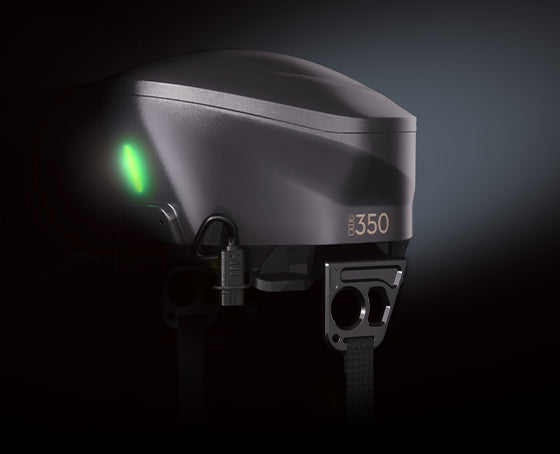
FlyFire's OWL-M350 parachute recovery system was engineered against this exact checklist, purpose-built for the DJI Matrice 350 RTK and backward-compatible with the Matrice 300 RTK.
- Fast, engineered response. Built on FlyFire's APS 3.0 deployment algorithm, the system reads DJI flight sensor data through the DJI PSDK interface to identify abnormal states (falling, overspeed, rolling, spinning, impact, blade vibration) and responds in as fast as 500–700 ms.
- Documented descent performance. A controlled descent rate of 3.5 m/s brings impact kinetic energy down to roughly 55 joules, comparable to a 0.7-meter free fall for the M350. That's a real, tested figure to work with when sizing your ground risk buffer.
- Motor-stop before deployment. The system communicates with the DJI flight control software to cut motor power ahead of canopy deployment, which addresses propeller entanglement directly instead of leaving it to chance.
- Dual, redundant IMU sensors. If one sensor path fails, a second independent path takes over data collection, so the system's situational awareness has no single point of failure.
- Independent backup power. A built-in battery keeps the OWL-M350 functioning for up to 30 minutes if the PSDK data connection or the aircraft's main power is lost, meeting the FTS independence requirement in practice.
- Lightweight and compact. At just 800 g with a folded footprint of 166×158×114 mm, it's rated for a 9 kg max load, with minimal impact on flight time or payload budget.
- No permanent airframe modification. The mounting hardware doesn't require dismantling the M350's original arm screws, and a single operator can install it in about two minutes.
- Manual trigger and audible warning. Remote pilots retain a manual override, and the system sounds an audible alert during a forced landing to warn ground personnel nearby.
- Built for real conditions. IP45 weatherproofing, an operating range of -20°C to +60°C, and a working altitude ceiling of 3,500 m.
What if you're planning to upgrade to the M400 eventually?
If your budget and mission requirements point toward the Matrice 400 — with more payload capacity, longer endurance, and more advanced obstacle sensing — that's a perfectly sound direction for the operations that actually need it. Upgrading doesn't mean your M350 investment was wasted. It means your fleet is evolving the way most enterprise fleets do, in stages, as capital and mission requirements allow.
What doesn't change is this: compliance follows the aircraft you're actually flying, not your upgrade roadmap. If your M350 is doing STS-01/STS-02 work today, it needs a compliant path today, regardless of what's on next year's capital plan. And when the time does come to move up to the M400, the compliance question doesn't disappear — it just comes with you. FlyFire builds recovery systems across the full Matrice lineup, including the OWL-M400 for the Matrice 400 RTK, so whichever airframe your fleet ends up flying, there's already a purpose-built option ready when you need it.